
.svg)
How Ecommerce Fulfillment Services Support Growth
Ecommerce fulfillment services help US businesses store, pick, pack, ship, and manage returns with speed, visibility, flexible capacity, and control daily.


.avif)
.avif)
.avif)
.avif)
.avif)
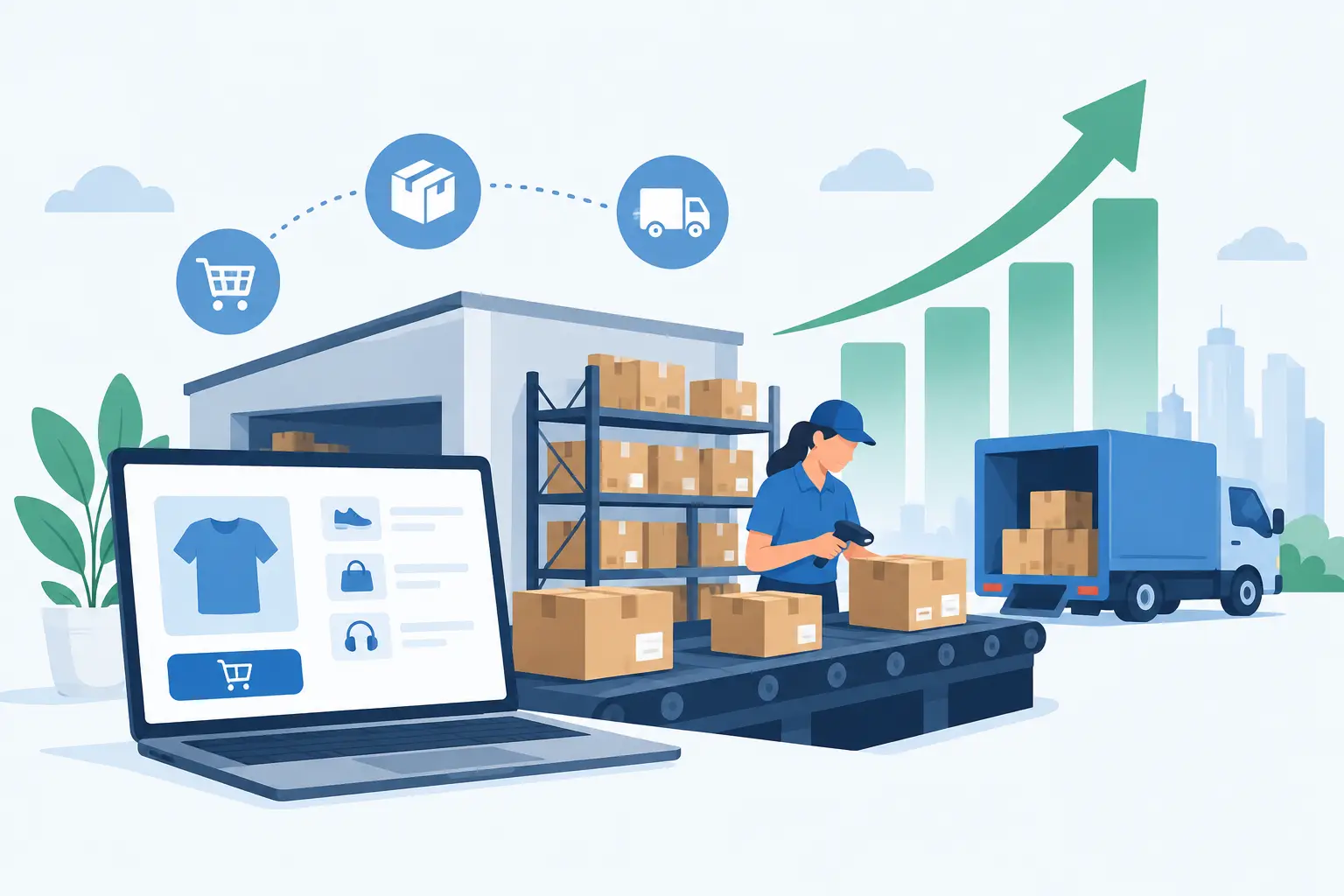
A delayed order is rarely just a warehouse issue. It can create a support ticket, cancel a repeat purchase, disrupt a retail replenishment cycle, or leave a marketplace seller below its promised delivery standard. Ecommerce fulfillment services exist to prevent those breakdowns by connecting inventory, order processing, transportation, and returns into one accountable operating flow.
For growing ecommerce businesses, the question is not simply whether to outsource fulfillment. It is whether a fulfillment partner can execute at the speed, service level, and visibility your customers expect without adding cost or operational blind spots.
What Ecommerce Fulfillment Services Actually Cover
Ecommerce fulfillment services manage the work between receiving inventory and completing a customer delivery. At a basic level, that includes storage, picking, packing, shipping, tracking, and returns processing. The right scope depends on the products, sales channels, delivery promises, and geography involved.
A fulfillment operation starts when inventory arrives at a facility. Products must be counted, inspected, labeled, and placed into locations that support accurate picking. When an order enters through an ecommerce platform, marketplace, ERP, or API connection, the fulfillment system should route it for pick, pack, carrier selection, and dispatch without manual reentry.
That workflow sounds straightforward until volume rises or product requirements become more demanding. Orders may contain oversized items, fragile products, temperature-sensitive inventory, serialized assets, or multiple pieces shipping from different locations. The operation must still produce accurate orders, meet cutoff times, and provide usable status updates.
Returns matter just as much. A fulfillment provider should receive returned items, inspect their condition, update inventory status, and route each unit to restock, repair, quarantine, disposal, or return-to-vendor. Slow or unclear reverse logistics ties up sellable inventory and makes finance teams work with unreliable stock data.
The Operational Problems a Provider Should Solve
Outsourcing fulfillment should reduce friction, not relocate it. A provider that only stores boxes and prints labels may be enough for a small, stable catalog. Businesses with more demanding delivery requirements need a partner that can manage exceptions, changing volumes, and transportation handoffs.
Order accuracy is the first test. Wrong items, missing units, and damaged packaging cost more than a replacement shipment. They consume customer service capacity and weaken trust. Strong fulfillment processes use barcode controls, location discipline, cycle counts, and exception handling to catch issues before an order leaves the facility.
Speed is the next test, but speed needs definition. Same-day order processing is useful only when the final-mile transportation plan can support the promised arrival window. A two-day ground shipment, a scheduled route to stores, and an on-demand local delivery are different services with different economics. The fulfillment model should match the customer promise rather than applying one shipping method to every order.
Visibility is equally practical. Operations teams need to see available inventory, orders in process, shipments in transit, delivery confirmation, and return status. When these records live in separate systems, staff spend time reconciling data instead of resolving issues. API integration can connect order sources and transportation systems so that status information moves with the order.
Choosing the Right Ecommerce Fulfillment Model
There is no single best model. The right approach depends on order volume, product characteristics, customer locations, margin structure, and required delivery speed.
A centralized fulfillment model can simplify inventory control and create scale in one operation. It often works well for national parcel shipping when demand is predictable and delivery times can accommodate carrier transit. The trade-off is distance. Customers near the facility may receive orders quickly, while distant customers face longer transit times and higher zone-based shipping costs.
A distributed model positions inventory closer to demand centers. This can improve delivery speed and reduce outbound miles, particularly for businesses serving major California markets such as Los Angeles, San Diego, the Bay Area, Sacramento, and Orange County. It also adds inventory-planning complexity. More locations can mean more safety stock, more transfers, and greater risk of imbalanced inventory if demand forecasting is weak.
Some businesses need a hybrid model. Parcel carriers may handle standard national orders, while local delivery capacity supports same-day orders, retail replenishment, high-value shipments, or urgent replacements. This is often the practical answer for brands that sell both direct to consumers and through commercial channels.
Where Transportation Changes the Fulfillment Outcome
Fulfillment and last-mile delivery are often managed as separate functions. That separation can create avoidable delays. An order may be picked on time but miss its delivery promise because carrier pickup schedules, route capacity, or address exceptions were not considered early enough.
A connected provider can make transportation part of the fulfillment decision. For example, route optimization can group local orders by delivery window, geography, vehicle type, and handling requirement. AI dispatch can help assign urgent orders to available capacity while recurring-delivery scheduling supports predictable routes to stores, offices, customer sites, or distribution points.
This matters most when standard parcel shipping is not enough. Consider a retailer that needs inventory transferred to several stores before opening, a healthcare supplier replenishing time-sensitive products, or a B2B seller delivering equipment to a jobsite. These orders may require multi-stop routing, proof of delivery, appointment coordination, temperature control, or white-glove handling.
EtaFlex supports this connected approach by combining fulfillment workflows with business delivery, route planning, dispatch automation, and specialized transportation. For operators, the practical benefit is fewer handoffs between warehouse activity and final-mile execution.
Questions to Ask Before Selecting Ecommerce Fulfillment Services
Before comparing pricing, define the operating requirements that affect service quality. A provider should be able to answer these questions with specifics, not general assurances:
- How are inbound receipts verified, and how quickly is inventory available to sell?
- What controls prevent picking, packing, and labeling errors?
- Which systems integrate with our ecommerce platform, ERP, marketplaces, and transportation tools?
- Can you support our cutoff times, peak-season volumes, and urgent order exceptions?
- How are returns inspected, dispositioned, and reflected in inventory records?
- What delivery options are available for oversized, sensitive, high-value, or time-critical products?
Pricing also needs context. A low per-order pick fee can be offset by receiving charges, storage minimums, packaging markups, account management fees, return processing, parcel surcharges, and peak-period costs. Ask for a model based on your actual order profile, including average units per order, SKU count, package dimensions, return rate, and destination mix.
Service-level agreements deserve the same scrutiny. Look beyond broad claims about fast shipping. Define order cutoff times, accuracy targets, inventory-adjustment procedures, delivery confirmation, escalation paths, and reporting cadence. The agreement should make it clear who owns a problem when inventory, fulfillment, and transportation data do not match.
Building a Fulfillment Operation That Can Scale
Scalability is not only about having more warehouse space. It is the ability to absorb a new sales channel, a promotional spike, a seasonal increase, or a tighter delivery promise without losing control of inventory and customer communication.
Start with clean product data. Every SKU needs accurate dimensions, weight, handling requirements, barcodes, and storage rules. A fulfillment team cannot consistently select the right packaging or transportation method when basic item data is incomplete.
Then establish operating rules for exceptions. Decide how to handle short picks, damaged items, address errors, split shipments, expedited upgrades, and customer-requested changes. These cases will occur. The advantage comes from resolving them through defined workflows instead of improvised emails and phone calls.
Finally, measure the metrics that affect commercial performance. Order accuracy, on-time shipment, on-time delivery, inventory accuracy, dock-to-stock time, return cycle time, cost per order, and cost per delivered unit reveal different parts of the operation. Reviewing them together helps teams identify whether a problem began in inventory, fulfillment, carrier handoff, or final-mile execution.
The most effective fulfillment partner becomes an extension of your operation, not another system to manage. Start with the customer promise you need to keep, then build the inventory, fulfillment, and delivery workflow required to keep it consistently.
Related Posts
Multi stop route optimization software helps delivery teams cut miles, protect service windows, manage exceptions, and run reliable daily operations at scale nationwide.
Same day delivery for businesses helps teams protect critical schedules, reduce downtime, and manage urgent shipments with clear operational control each day.
Scheduled delivery routes for businesses create planned capacity, dependable handoffs, and delivery visibility for recurring commercial work each workday.
Never Miss an Update
Subscribe to Our Newsletter
Stay informed with fresh logistics content delivered straight to your inbox.